
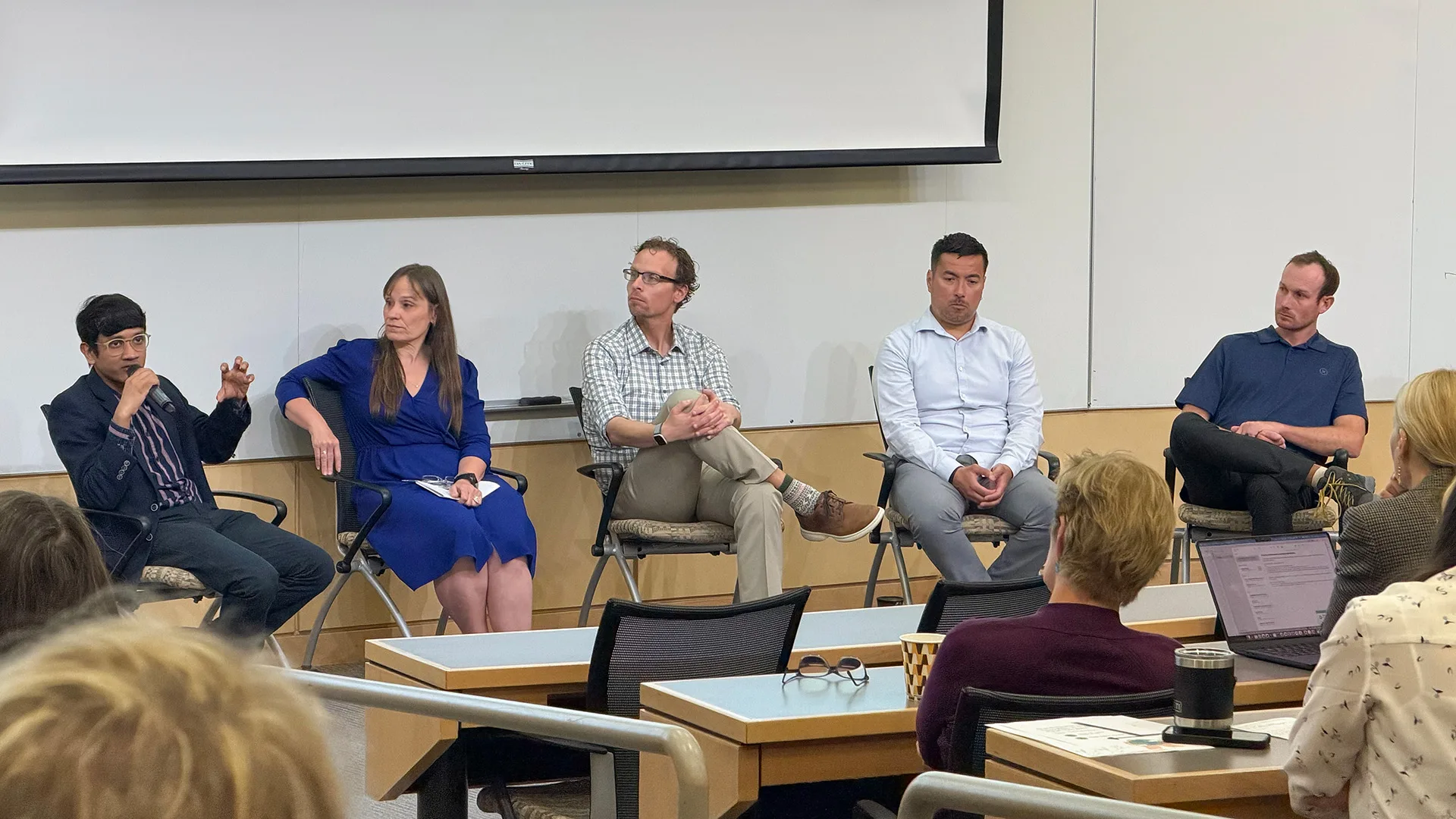
Behind every AI prompt is a chain of physical infrastructure—from data centers and power grids to cooling systems, mined minerals, and discarded hardware—with consequences for people and the planet, University of Utah researchers reminded the campus community during an Earth Month panel discussion.
“We have millions of users that are hitting enter or submit at any one time, which depend on real physical infrastructure, which, in turn, has real physical impacts to local communities,” said panelist Jon Fisk, an associate professor and associate director in the School of Public Affairs.
The April 15 discussion, co-hosted by the College of Nursing and the One-U Responsible AI Initiative (One-U RAI) at the Scientific Computing and Imaging (SCI) Institute, focused on AI and sustainable innovation in higher education. Fisk and four other U researchers discussed AI’s environmental costs, efforts to build more sustainable systems and advance environmental science, and how faculty, staff and students can use the technology more critically and shape its future.

What powers AI—and what it leaves behind
Panelists described AI’s impact as both global and local. Training and running AI models requires large amounts of energy, often drawn from fossil fuels rather than renewable sources. When fossil fuels are burned, they emit carbon that warms the planet and worsens extreme weather such as wildfires and droughts. Data centers also require water for cooling or power generation and can affect nearby communities through air pollution, noise, heat islands, pressure on local utilities, and land-use changes, including the conversion of farmland.
Rohan Basu Roy, assistant professor of computing and a SCI faculty member, said U.S. Environmental Protection Agency frameworks can help researchers translate pollution from data centers into estimated health costs. For one Virginia data center that draws on-site power from natural gas turbines and diesel generators, that amounts to tens of millions of dollars tied to premature mortality and respiratory and cardiovascular disease.
Electronic waste adds another challenge. As companies race to build faster AI systems, hardware can be retired before the end of its useful life, increasing demand for minerals and metals while adding to the waste stream.
“The takeaway here is that AI really is a double-edged sword,” said Tabitha M. Benney, professor and associate director of the School of Public Affairs. “Its current environmental footprint is quite massive, but it has a lot of promise for also helping progress in protecting the environment.”
Building sustainable AI and using it to solve environmental problems
Roy is working on one part of the solution: building AI systems that use less energy. He and his collaborators focus on energy-efficient AI models and computing architecture, including how large language models are placed and run on graphics processing units, or GPUs, the chips powering much of today’s AI use. Roy’s research isn’t just theoretical: it’s deployed through the Argonne National Laboratory, which hosts large scientific models for the Department of Energy. Plus, U students trained in these methods carry that expertise into jobs with GPU-makers such as NVIDIA and AMD.
Other U researchers are using AI to improve environmental decision-making. Ryan Johnson, One-U RAI faculty fellow and assistant professor of civil and environmental engineering, uses machine learning to better estimate mountain snowpack, a critical water source for Utah and the West. “By integrating machine learning throughout hydrology, we expect substantial improvement in forecasting,” Ryan said.
His team combines data on terrain, vegetation, and past snow conditions to identify sampling locations that will produce more accurate watershed estimates—leading to better water management. In addition to the Western U.S., Johnson conducts this work in Alaska, home to some of the least monitored and modeled waterways in the country.
Daniel Mendoza—research assistant professor of atmospheric sciences and a member of a One-U RAI seed grant team—is teaching an Honors College Praxis Lab through fall 2026 in which students use AI to study how Salt Lake City’s Green Loop could reduce urban heat. Students survey residents, examine green infrastructure projects around the world, and analyze satellite and land-based data to help identify tree species, locations, and planting strategies that could cool neighborhoods while accounting for water use and long-term maintenance.
Teaching critical use and civic action
Panelists said faculty and staff can help students think critically about when and how they use AI. One practical step, Roy said, is encouraging students to use smaller AI models for early brainstorming or routine tasks before turning to larger, more energy-intensive models.
But panelists emphasized that individual choices are not enough. AI sustainability is a policy issue, shaped by decisions about utilities and natural resources and influenced by community engagement. Benney and Fisk said students should know about AI’s impacts, who makes decisions about data centers and energy and water use, and how to participate.
Policy options for data centers include monitoring water and energy use, requiring use of renewables instead of fossil fuels, and mandating information transparency. “We could require data centers to disclose that they will use the equivalent amount of energy of 90,000 homes, and lawmakers could decide if that information is made public,” Fisk said. “That is their policy choice.”
Benney also encouraged researchers to think beyond academic audiences. Partnering with social scientists, she said, can help faculty translate technical findings into language that resonates with communities and policymakers who can act on the work. And framing research in terms of health and economic impacts, such as the cost to taxpayers, can make it more influential.
Benney said she hopes U faculty members are inspired to discuss AI’s sustainability issues in their courses and beyond. “We often sit at the table and can influence the decision-makers here at the university and in the local government,” she said. “I really encourage you to get out and spend some time being role models in that area.”
