
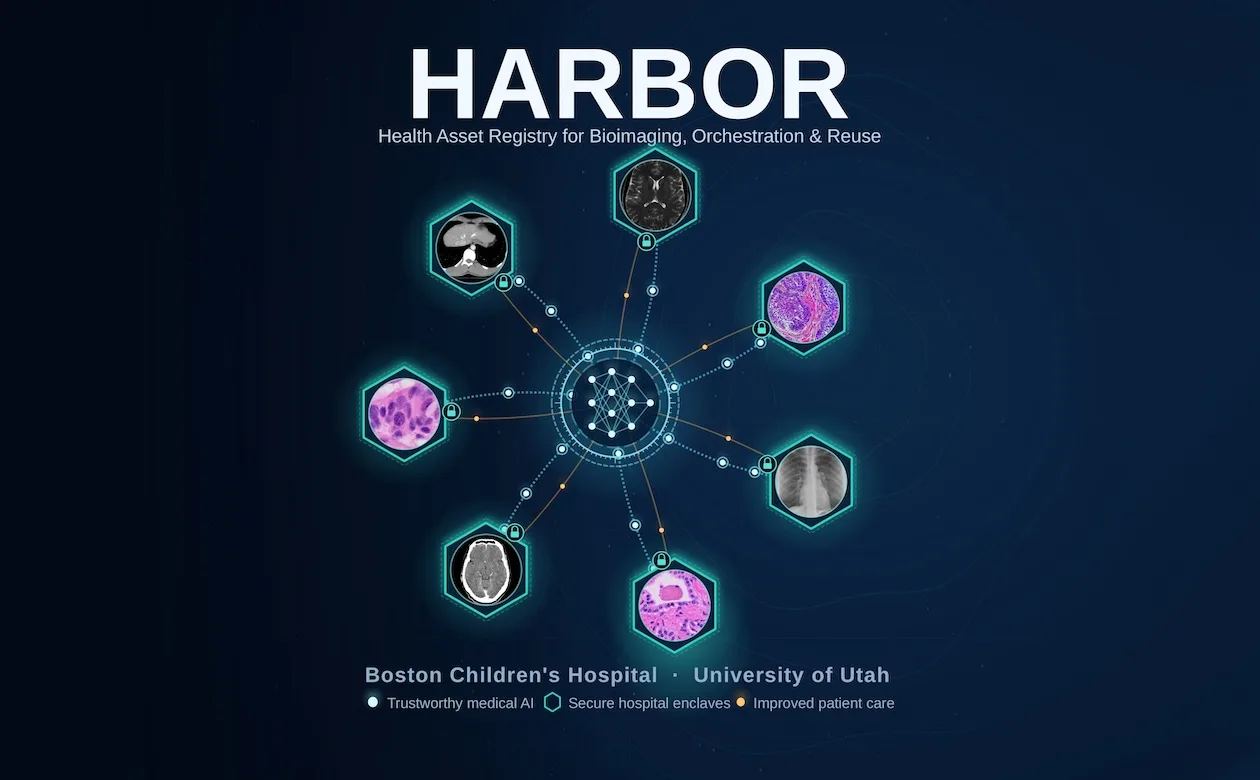
A three-year, $42M ARPA-H initiative to improve patient care by expanding access to medical data and computational resources that advance research and innovation while protecting patient privacy.
Medical data holds the key to more individualized patient care, fueling the research and development of artificial intelligence (AI) tools that make it possible. Because hospitals rightly put patient privacy first, this data often remains out of reach of the researchers and companies best positioned to drive this innovation. Further, few researchers and small companies focused on rare diseases or rural health have access to the compute power and infrastructure needed to develop relevant AI tools. The University of Utah and Boston Children’s Hospital have received a three-year contract for up to $42 million from the Advanced Research Projects Agency for Health (ARPA-H) to build HARBOR (Health Asset Registry for Bioimaging, Orchestration & Reuse). Funded through ARPA-H’s Health Science Futures Office, HARBOR will be a secure national platform that brings research and AI development to medical imaging data where it already lives, so patient data never leave the hospital, with the ultimate goal of improving patient care. At ARPA-H, HARBOR is led by Program Manager Ileana Hancu Ph.D. The HARBOR project is in partnership with the Office of Science and Engineering Laboratories (CDRH/FDA) under the direction of Aldo Badano (Director, DIDSR/OSEL/CDRH/FDA).
HARBOR will provide hospitals with a secure environment to host their data as part of a new secure federation spanning public clouds, and hospital infrastructure. To protect patient privacy, the platform will federate analysis across hospital environments, under strict hospital governance, allowing innovators to analyze data without exposing any patient data. Furthermore, HARBOR will make available the computing infrastructure and address the data standardization, cleaning, and de-identification challenges needed to unlock innovation by a broad community. For example, unlocking critical research for underserved areas like pediatric and rural medicine that typically receive little industry attention.
HARBOR’s University of Utah team will be led by Valerio Pascucci, director of the Center for Extreme Data Management Analysis and Visualization (CEDMAV), a professor in the John and Marcia Price College of Engineering’s Kahlert School of Computing, and a member of the U’s Scientific Computing and Imaging Institute, along with Giorgio Scorzelli, director of software development at CEDMAV. The Boston Children’s Hospital team will be led by Ellen Grant. The initiative will establish a new commercial venture led by Dr. Ouwen Huang.
“This project has tremendous potential to change how medical AI is built. The imaging data needed to train better models already exists, but it sits in thousands of separate systems that were never designed to work together. Moving that data is slow, costly, and risky for patient privacy, and that friction holds back research and the tools patients are waiting for,” says Pascucci. “HARBOR flips the model. Instead of moving data to the computation, we bring the computation to secure enclaves near the data, so hospitals keep full control of their patients’ images while researchers can learn across institutions at a national scale.”
Building on the federated storage infrastructure developed by the National Science Data Fabric and the OpenViSUS data streaming capabilities, HARBOR will provide the secure, distributed, collaborative infrastructure medical imaging research teams need to advance trustworthy medical investigations. The Utah team will also lead the development of HARBOR’s federated learning capabilities, which allow medical AI models to be developed on data cohorts fully representative of the U.S. population, including secure, complete representation of all demographic groups, so the medical devices developed can have the widest possible impact.
In addition to data access, HARBOR will provide resources for image processing and machine learning (ML) tool development. This will help streamline the development and testing of imaging-based AI technologies while supporting research that aligns with regulatory requirements and advances healthcare innovation.
“The limiting factor in medical AI is no longer the algorithms. It’s the infrastructure to learn from data that can’t leave the hospital,” says Charles Musgrave, dean of the Price College of Engineering. “That is fundamentally an engineering problem, and HARBOR is an engineering answer at national scale. Just as important, it’s shared infrastructure, so rural hospitals, pediatric researchers and small companies can build AI for the patients they serve, not just the few organizations that can afford their own data centers.”
“Breakthroughs only matter when they reach patients, and in medicine today that increasingly depends on how well we use data,” says Bob S. Carter, Executive Vice President for Health Sciences at the University of Utah and CEO of University of Utah Health. “As a neurosurgeon, I have seen how much imaging guides every decision we make, and how much more we could learn if insights could be shared across institutions. HARBOR accelerates practical use of responsible AI, and reflects our vision of turning technological innovation into better care for the people of Utah and the nation.”
“HARBOR is exactly the kind of public-private partnership the University of Utah wants to lead,” says James M. Hotaling, Associate Vice President for Research Innovation and Translation of the University of Utah, Chief Innovation Officer at University of Utah Health, and Professor of Urology at the Spencer Fox Eccles School of Medicine. “Our health system and our researchers hold deep expertise and valuable data, but innovation only matters when it reaches patients. By connecting hospitals, AI developers and industry on a secure, privacy-preserving platform, HARBOR creates a clear path from discovery to new medical devices and clinical tools. It’s how we turn data and ideas into better, more precise care, and it’s a model for responsible AI in health care.”
The University of Utah’s team brings together leaders in the field, including Curtis Langlotz, Eric Yang, Rebecca Rojansky at Stanford University, Spyridon Bakas, and Michael Feldman at Indiana University, Marius Linguraru and Syed Anwar at Children’s National Hospital, Rajendra Singh at PathPresenter, Mei Wang at Instapath, Alexandros Karargyris at MLCommons, Jonathon Quincy Brown and Brian Summa at Tulane University, Beatrice S. Knudsen and Attila Gyulassy at the University of Utah.
HARBOR aims to create a sustainable national resource to advance medical imaging research and responsible healthcare AI development.