
As U.S. sprinter Noah Lyles surged in the final stride to win the men’s 100‑meter dash at the Paris 2024 Olympics—the closest finish in modern history—The New York Times graphics team faced a race of its own. Within hours, they published an intricate visualization of the event, powered in part by the work of University of Utah Scientific Computing and Imaging (SCI) Institute PhD student Kalina Borkiewicz.
Borkiewicz, who previously spent a decade at the University of Illinois at Urbana-Champaign’s National Center for Supercomputing Applications (NCSA), had never experienced anything like it. “The 100-meter race is 10 seconds. It’s such a small window to be there, and get it right, and get it done,” she said.
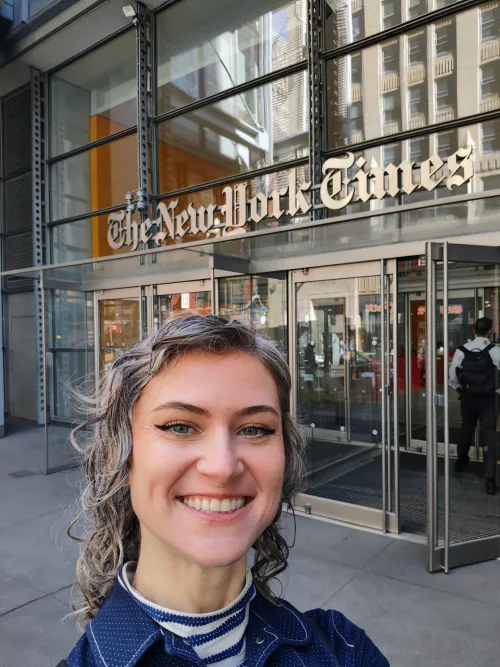
The Times graphics team worked for about two months beforehand to come up with an innovative way to cover the event—something worthy of the country’s most-read news outlet—but they still had to execute in the moment. “It was exciting, especially at the level of The New York Times,” Borkiewicz said. “That’s a lot of pressure, and once it was out there, it was such a relief.”
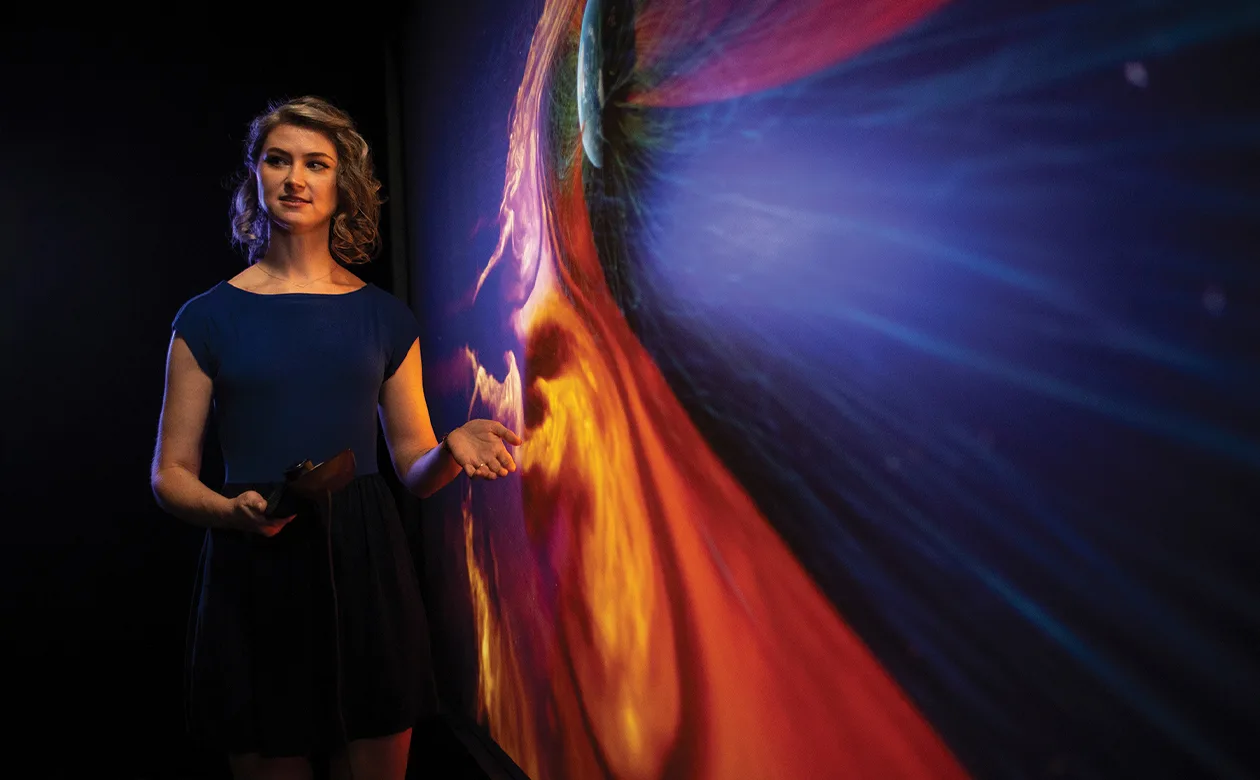
Borkiewicz was new to breaking news, but a veteran of high-profile projects. At NCSA, she started as a research programmer and later led two groups: the Advanced Visualization Lab and a Visualization Program Office that she created. She specialized in cinematic scientific visualization, which means taking raw scientific data about things like tornadoes, galaxies, or molecules and transforming it into imagery for museums, concerts, and films, including the acclaimed IMAX documentary A Beautiful Planet.
At The Times, Borkiewicz and the graphics team used data from previous Olympic races to create a computer vision and machine learning pipeline to track athletes’ speeds from burst photography. Borkiewicz’s main contribution was the images-to-positions part of that pipeline. (A funny side note from the PhD student: the team had to pick a single body part to track across all image frames, and they chose the ear. “I created an ear-picking tool that I jokingly named ‘Q-Tip,’” Borkiewicz said.) Her colleagues carried the project forward from positions to speeds, and then to the final visualization.
In late August 2025, about a year after publication, the team earned one of the industry’s top honors: the Online Journalism Award for Excellence in Sports Reporting in a large newsroom. “Great storytelling on many levels,” judges’ comments read. “Accessible, engaging, thoughtful presentation that for many readers could be as rewarding as watching the events themselves.”
Borkiewicz was thrilled and surprised. “It’s surreal to be an award-winning sports journalist when I do not even follow sports,” said the PhD student, who prefers other hobbies: she read 61 books last year and enjoys spending time with her 100-pound Goldendoodle, Moose. “What I love about visualization is that every project forces you to learn something new very quickly. This project is a great example of going from zero to expert in a short amount of time.”
The journalism honor wasn’t Borkiewicz’s only success. Around the same time, she was also elected to the Executive Committee of the Association for Computing Machinery Special Interest Group on Computer Graphics and Interactive Techniques, better known as ACM SIGGRAPH, the leading professional organization in computer graphics.

“Being chosen feels like an incredible honor and a big responsibility,” she said. In addition to digging into essentials like budget and strategy, she’s excited to use her SIGGRAPH role to uplift others in her field.
“I want to expand SIGGRAPH’s reach beyond entertainment into communities like visualization and computer vision, and I also want to strengthen diversity, equity, and inclusion across the organization,” she said. “I’ve already been involved with those efforts through Women of SIGGRAPH Conversations, and now I have the chance to carry them forward at a larger scale.”
At SCI, Borkiewicz researches how to make complex 3D information understandable to the general public. “We live in a time when misinformation and distrust of science and AI are everywhere. Visualization can cut through that by making science approachable and easier to understand,” she said.
The U, she said, is a natural fit for her. “Utah is the home of computer graphics, and SCI has an unmatched visualization community. It was the obvious choice for me to build on my 10 years at NCSA and to study how practitioner practices, audience perceptions, and AI shape design.”
SCI has already helped, Borkiewicz said, by surrounding her with brilliant mentors and peers. “My advisor, Kate Isaacs, is an incredible mentor. She is brilliant and constantly pushes me to think in new directions, but at the same time she is very supportive of my own goals and research ideas.”
Isaacs said she’s thrilled to see Borkiewicz—who is smart, curious, motivated, and organized—use her PhD studies to further broaden her portfolio of high-impact work. “Kalina’s continued connection with the practitioner side of data visualization gives her a valuable perspective in motivating her research towards actionable results,” Isaacs said.
Borkiewicz hopes to finish her PhD around 2028. After that, she sees herself working in research and development in industry, where she can stay close to both innovation and application. For now, she uses internships as a way to try on different hats: this summer, she’ll lend her talents to the Apple headquarters in Cupertino, California.
In addition to her peers and mentors at the U, Borkiewicz draws inspiration from Donna Cox, a past mentor at NCSA. Borkiewicz worked with Cox for eight years, and when the professor retired, Borkiewicz led her lab. “She was a pioneer of cinematic scientific visualization and an artist who carved out space for herself and her team in a supercomputing center,” Borkiewicz said. “She showed me that it is possible to invent your own path, and that is what I am working toward.”