
Connecting leaders in exploration with Utah’s integrated research community.
Amanda Ashley, Director of Communications for Research and Innovation, Office of the Vice President for Research
When NASA leadership visited the University of Utah in February, the conversations quickly moved beyond introductions. What unfolded was a substantive exchange about how complex problems — in space and on Earth — demand integrated thinking.
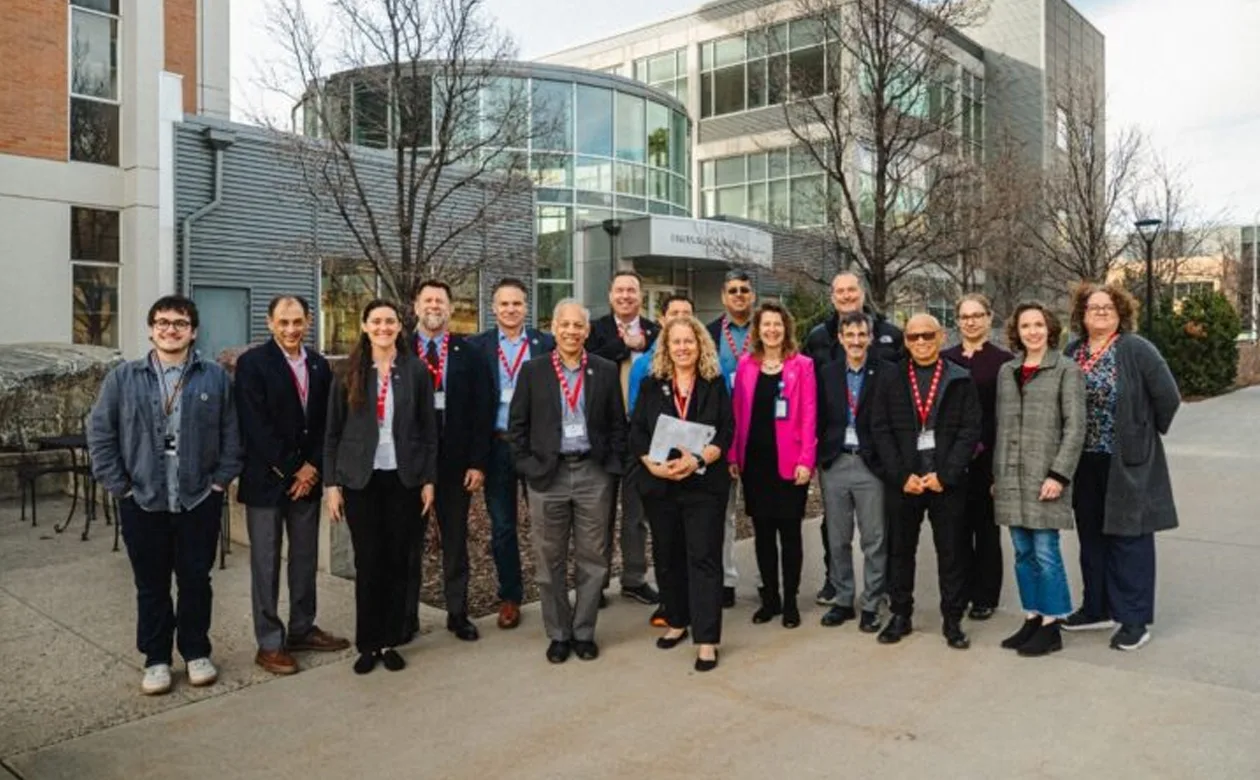
The visit, hosted by Marian Rice, Director of the University of Utah’s National Lab and Security Office, and Manish Parashar, Executive Director of Scientific Computing and Imaging Institute, brought together senior NASA leaders, including Deputy Center Director – Dr. David Korsmeyer, and U faculty from across disciplines for a focused day of discussion and discovery. The delegation represented a wide cross-section of NASA’s mission: exploration technology, human systems integration, intelligent systems, advanced supercomputing, airborne science, and engineering. Their presence reflected the reality of modern exploration — that success depends not on a single breakthrough, but on how well systems, people, and technologies work together.
That perspective aligned naturally with the work happening across campus.
Research Without Silos
Throughout the day, Utah faculty shared research spanning aeronautics, artificial intelligence, advanced manufacturing, environmental systems, wildfire, mechanical engineering, computing and data, and applied mathematics. What stood out was not just the technical depth of individual projects, but how frequently they intersected.
Computing and data research support aerospace design. Environmental modeling relies on high-performance simulation. Advanced materials development informs both aviation and space systems. Human-centered design shapes how complex technologies are built and deployed.
The discussions were practical and forward-looking. Where are the strongest points of overlap? How can university research move from promising ideas to mission-relevant applications? What would meaningful collaboration look like over the next five to ten years?
Rather than a showcase, the sessions felt like working conversations.
Making NASA Tangible for Students
A highlight of the visit was the opportunity for students to hear directly from NASA leaders.
For many, NASA exists primarily as an outcome — a launch, a discovery, a milestone mission. Hearing from the people responsible for shaping intelligent systems, guiding human systems integration, or leading advanced computing and data efforts helped clarify how those outcomes are built.
Students asked about career pathways, interdisciplinary training, and the evolving skill sets NASA values. The answers emphasized collaboration: engineers who understand computing, data scientists who appreciate physical systems, designers who account for human performance in extreme environments.
The takeaway was clear: exploration is not distant from the University — it is deeply connected to it. It is enabled by interdisciplinary teams, advanced research infrastructure, and the students who will carry this work forward.
From Concept to Capability
Tours of campus facilities reinforced that message. In nanofabrication cleanrooms, advanced manufacturing spaces, aerospace labs, and additive manufacturing centers, research moves quickly from theory to prototype.
NASA leaders saw an ecosystem where ideas can be designed, modeled, fabricated, and tested within a coordinated environment. That capability — the ability to connect computing power, materials science, engineering design, and human systems research — mirrors the systems-based approach NASA itself relies on.
The alignment was evident not only in subject matter, but in mindset.
Looking Ahead
The visit concluded with a focus on next steps, but the most significant outcome was shared clarity. The challenges NASA faces in the coming decade — sustained lunar exploration, deep-space missions, increasingly autonomous systems, climate and airborne science — require durable academic partnerships.
What emerged during the visit was less about a single project and more about long-term alignment. Both institutions are working at the intersection of disciplines. Both are focused on translating research into real-world impact. And both recognize that complex problems are best addressed collaboratively.
Want to learn more about NASA? View NASA Overview Presentation
Banner Image: Office of the Vice President for Research
Original article from https://www.research.utah.edu/research-impact/nasa-lands-at-the-u/